
welcome to my town
in which i have a few things to say about punctuation and capitalization and the like and, hey, you’re fine, take a breath

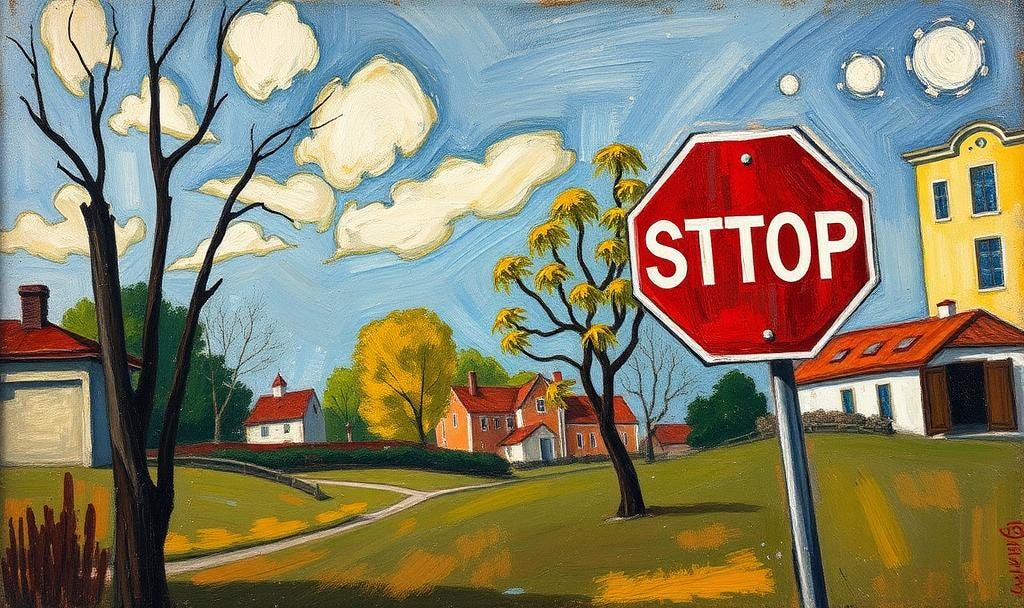
Since joining Substack, I’ve noticed a few recurring themes in my feed. There are some real puzzlers in there, but one theme in particular keeps hitting me in the face like a hot, wet fish.
Does the improper use of punctuation and capitalization employed by some writers here on Substack turn off anyone else completely? Is it just me? I mean, I’m great, yet I still find myself so inordinately frustrated by “writers” who can’t be bothered to stop and learn the basic rules of writing that I can’t make it a paragraph deep into their strange little word caves without screaming at my children and my neighbors [PASSIVE AGGRESSIVE SEMICOLON] what I’m really saying is, maybe I could finish reading these efforts and actually take something away from them if they were written properly. It just makes me want throw my Substack Omnibus—which I print out every morning onto a ream of paper and have spiral-bound in colored plastic that corresponds with the day of the week—right the fuck out of my goddamn window.
Like and subscribe! I’m having a tough time…
The above is not actually a quote even though I put it in block quotes. It’s a pastiche. Please don’t be mad.
Let’s take a step back.
First of all, thank you so much for inviting our kids to Ripley and Connor’s birthday party.
Twins! I can’t imagine! Sorry! I know! I’m sure you must hear that all the time!
I love these decorations! I never would have thought of “The Good Old Days” as a theme for a birthday party for children, but… How did you manage to find so many Cabbage Patch dolls? What’s that? Oh, you made them! That is… Hmm? Oh yes, soft sculpture is… Well, it’s a real tradition, isn’t it? Yes. Yes. A dying art, yes.
You must be exhausted. Sit with me a minute? It seems like the other parents have a handle on the kids for the time being.
Have I ever told you that once upon time I taught and tutored English? The students were all ages—from roughly second grade to twelfth grade.
Oh, I have? Sorry, my memory isn’t what it used to be. But I’m almost certain I haven’t run you through my whole “punctuation as traffic signals” bit.
Trying to teach kids the rules of writing, well… It’s interesting. When they’re young enough, they might as well be on magic mushrooms. You’ll be up there at the whiteboard, thinking you’re knocking it out of the park by drawing your little stick-figure cats “in” a house and “on” a house and then “behind” a house, and then you’ll turn around and you’ll find that two or three of your students have flopped out of their desks. They’ll be rolling around on the floor and looking at their hands.
When they’re that age (and likely for another year or so) you’ll be able to connect with some of them directly. They just need to hear you say whatever the thing is a bunch of times and they need to see tons of examples. But God help you if you tell them something like, “A period is like a stop sign.”
“Stop signs are red!” they’ll say, beaming.
They’re not wrong!
But long about fourth grade, most of them will be down to follow you on your figurative language trip. Every kid is different, but in my experience, you can really lean into this kind of teaching when they’re right around that age.
Sit, sit! Ripley’s fine. Look, she’s already stopped crying. Arsenic’s dad has this one covered. Can I get you another bottle of fashion water? A Capri Sun?
Fourth grade is also around the time they start asking, “Why?” whenever you teach them a new language rule.
And they’re not just being jerks! They really want to know! They want to get it!
“We’re following you, dude,” they’ll say, “but why is there a comma between these two clauses but not between those two clauses? Seems kind of random from where we’re sitting.”
So I did what I had to do. For a while, I just said, “Um…”
But teaching those rules day after day and year after year, I started to summon up some analogies—some landed better than others. This is when the patent-pending Mr. Paul’s Extended “Traffic Signs” analogy began to blossom like a lotus flower. Periods are like stop signs. Commas are like yield signs.
Et cetera.
Different kinds of clauses come together like different kinds of intersections. You just need to pick the sign least likely to cause an accident and/or annoy people. We don’t usually stick a comma between an independent clause and a dependent clause because a comma is like a yield sign and a subordinating conjunction is also like a yield sign, and you wouldn’t need two yield signs, would you? That would be silly.
You wouldn’t want to suddenly stop your reader while they’re driving at speed on the highway. You wouldn’t want to let your reader fly through an intersection. That’s how accidents happen. But you can help prevent these tragic accidents! With punctuation.
I won’t bore you with the whole spiel. It gets a little more complicated when you start throwing in em dashes and relative clauses and all that, but it’s fine. It’s teachable. Maybe someday I’ll write and publish my version of Strunk & White for kids that has pictures and stuff. Maybe it comes with a pair of dice. Anyway, I’m sure you haven’t thought about this particular glossary of terms in years. You’d need a refresher before we kept going. Or maybe you wouldn’t, I don’t know. Based on your strong distaste for writers who do writing wrong, it stands to reason that you must be very good with rules of writing and still have all of the terminology locked and loaded, ready to do correctness battle.
Suffice it to say, the kids liked the traffic analogies. It worked for most of them most of the time. The other ones would come along when they were ready if you kept at it with examples. Generally speaking, kids like it when you mark up a sentence on the whiteboard with octagons and triangles and what have you. They like it when you draw the streets of a make-believe town and send clauses through the intersections to see what happens. It becomes like a game.
Which brings me to my larger point: Writing is a game. It has always been a game. It’s a neat trick that humans can do. And if you want to take it more seriously than that, that’s fine too. It’s been elevated from a game to an integral part of civilization—civilization being another neat trick that humans do. Humans are games all the way down is what I’m saying.
“My teacher told me a comma means you take a breath,” a student would say.
“Well,” I would say, “Which kind of breath? A quick breath or a long breath? Or something in between? Is a period not like a breath? Is a semicolon not like a breath? And have you considered that maybe it’s the other way around? That taking a breath means you should use a comma? Because we took breaths first, you know? We did a whole lot of speaking before we came up with writing. If punctuation marks and conjunctions are the traffic signs that keep us from confusing our readers with our writing, then why don’t people get confused when we speak aloud the same ideas? We’re not using punctuation when we speak, but everyone seems to get along well enough. Well, the thing is, we are using punctuation when we speak. We’re using short breaths and long breaths and soft tones and loud tones and up sweeps and down sweeps and hand gestures and facial expressions and all kinds of other subtleties to punctuate everything that we say. We’ve been writing for about five-thousand years and we’re still trying to figure out how to punctuate our ideas when we write them down as well as we do without even thinking about it when we say them aloud. It’s just one of those things.”
“Can I go to the bathroom?” they would say.
“You just went to the bathroom,” I would say.
“That’s true,” they would said. “But if we’re still figuring out the best way to write ideas down, then why do we have to learn all these rules?”
“Well, you don’t.”
“We don’t?”
“You’re in fourth grade. You’re basically voting at this point. If you want to get a good grade, then you have to learn these rules. If you don’t, you don’t. If you want people to understand what you’re saying when you send them a cover letter to apply for a job, it’s probably a good idea to learn the rules now while you’re young. But maybe you don’t want that kind of job. Maybe you’d be more comfortable working somewhere that’s a little more flexible and a little less pedantic when it comes to this sort of thing.”
“Are teachers allowed to say that?”
“Maybe,” I would say. “I don’t know, man. I’m not a real teacher. I’m just trying to figure out what comes next for me.”
“Okay,” they would say.
“Listen, I was terrible at this when I was your age. It was impossibly hard for me. I got math. I didn’t get this. I felt really embarrased by it. I struggled with this all the way into college. It wasn’t until I started writing solely because I wanted to express myself that the rules started to make sense to me. I finally learned them because I realized that I would need to if I was going get my thoughts out there to the widest possible audience.”
“Hmm,” they would say.
“Anyway, I highly recommend that you learn these rules. If a big city didn’t have traffic rules, it would be a mess. No one would ever get anywhere. People would misunderstand each other all the time. There would be accidents all over the place.”
What’s that? Oh, no, I don’t tutor anymore. No. No. I mean, I can ask around, but I’m not really connected to the education world these days. Connor seems fine. He’s four years old. Give it a little time, yeah? His resume? I don’t think a four year old really needs… Oh, he did? Really? His picture right there on the cover, huh? Well, good for him! Oh, actually, don’t look now, but he’s eating a… Oh, nevermind. Safeword’s mom just stepped in there to save the day. It really does take a village.
Anyway, I’m almost done, I promise, but I really want to finish my thought. If we stop here, it might seem like I’m strict about grammar and punctuation if only begrudgingly because I see its utility in our society, but that’s not exactly the case.
So anyway, the kid would say, “But my friends and I never use punctuation when we’re writing to each other and no one ever gets confused.”
“That’s a very good point!” I would say. “But it’s not that you don’t have rules. It’s just that you have your own rules. It’s like a small town that’s just for you and your friends. There are only a few roads and everyone knows each other. You don’t really need traffic signs. Plus, you have emojis. They’re doing a ton of the heavy lifting. The important thing is that you all understand one another.”
“Huh,” the kid would say.
“But life is weird,” I would say. “It’s never that simple. As far as writing is concerned, you live in the big city and several small towns all at the same time.”
“Mr. Paul, you are blowing my mind right now,” the kid would say.
“I mean you text your parents differently than you text your friends, and both of those are way different than the way they expect you to write at school—that’s two towns and a city right there.”
“I’m not allowed to have a phone yet.”
“Well, sure. That makese sense. Someday, kid. Anyway, I recommend that you learn these rules because you’re going to need them so people in the big city will take you seriously. Even if you don’t wind up taking the people in “the big city” seriously and you feel like telling them that their rules are old and dumb, you might find that you need to at least have a passing familiarity with their rules so they understand what you’re saying when you tell them that their rules are old and dumb. And when you and your friends decide to build your own city, you’ll at least have been to a city before. You won’t be starting from scratch.”
Anyway, that’s what I would tell the kids.
But there are a few other things I’d like to tell you while we’re sitting here because we’re fucking grownups.
Hmm? Oh, hey, don’t worry. It’s fine. We’re allowed to say “fucking grownups”. Interestingly, it’s because we’re fucking grownups. The kids? They’ll be fine. They’re way over there, digging through that trashcan like a family of raccoons.
The things I hope to impart unto you, grownup, are these:
Whenever you encounter a “typical English-speaking person” writing on Substack (or anywhere else) who you think “should” know the rules of the written road because you ostensibly speak the same language, just try to remember that there are a lot of reasons they may not have populated their town with the signs you’re familiar with. Maybe they want to learn the signs you’re familiar with, but it’s all still new to them. Maybe they’re just now finding their voice and they’ll get around to it. Maybe there’s a libertarian vibe in their town. Not my cup of tea, but fine. Maybe they just don’t want Big Grammar telling them what to do. Maybe there are signs in their town but you just don’t see them because you don’t live there and you don’t know what to look for. Maybe they didn’t have the same opportunities to learn the signs that you had. Maybe they have a learning disability and have struggled with signs for as long as they’ve been asked to learn them. Maybe they know the signs better than you do and they’re subverting them because they can—because they want to take you to a wild-ass town if you think you can hang. None of the reasons they may have for not executing rules the same way that you do invalidate their ideas.
And I assume we don’t need a refresher on how rules in academia have—sometimes accidentally and sometimes purposefully—distinguished people who are in the special club from people who are not in the special club? We don’t? Great. Same page.
In other words, whenever you read anything that anyone has put out into the world, remember that they put it out into the world because they’re hoping someone else will read it—hoping that someone will see them. For that reason, there are a few invisible but strongly implied sentences between every title and its first paragraph. If you could see them, they would read something like this:
Hello. Welcome to my town. I like it here. I’m a little nervous, but I’m very excited to have a visitor.
Visiting someone’s town and telling them that you can’t stand the way they’ve organized things is unkind.
Telling a crowd of people the same thing in a stage whisper that’s loud enough for the town you just visited to hear is beyond the pale—not to mention it’s just plain cowardly.
Maybe their town is not for you. That’s fine. Maybe you won’t be visiting again. But look around while you’re there. Meet the people. Have lunch at the diner and chat up the server at the counter. Walk along their streets and see if the signs don’t start to make sense to you after a little while. Get some ice cream. Have a beer. Take a breath.
And after all that, if you still decide you’re never going back, that’s fine. But please don’t write a blog about how shitty you thought their town was. That’s somebody’s home. Definitely don’t write a passive-aggressive blog about how “frustrating” you thought their town was and how it could be less frustrating for you and better for them, really, if only they would discipline themselves enough to follow the rules.
Was there something actually shitty there? Was it full of nazis? Yes? Then good instinct on your part. Call a nazi a nazi. Warn people not to visit the nazi town. But differently-capitalized titles and “missing” commas are not nazis. They’re not high rates of violent crime. They’re not a tire fire. They’re not widespread racism and misogyny. They’re not an outbreak of dengue fever. They’re not an unattended chemical spill. They’re not hyper-intelligent, four-foot-tall spiders.
Be reasonable. Be kind. Don’t be a butthead. You’re a guest.
No, you’re right, I think you’d better check in with Ripley and Connor at this point. That’s a pretty sturdy-looking table, but I don’t know how long its legs are going to hold out if they keep doing what they’re doing. Twins! I can’t imagine!