
Diamonds Forever
In which an older man grooms me and a visual poem is born

I’d gotten used to saying, “Yes sir,” to retired military guys
As a seventeen-to-nineteen year old, I waited tables at a small, family-owned BBQ restaurant in my hometown.
I personally took the phone call to cater a rally for John McCain’s 2000 presidential Republican primary campaign.
Once, I delivered a large carryout order in my Volkswagen Golf to one of the construction crews repairing the Pentagon just days after 9/11. (I accidentally drove up the bus route. Another young person who was working his own post-high-school job pointed an M16 at me.)
I liked my job. A lot. I was good at it. I’d been promoted to Baker, where I made nine dollars an hour—a fortune. Then I’d been promoted to Caterer, where, when not catering, I had to work in a windowless basement office with management. I sat at a shared computer station, did data entry, and answered phone calls.
George and January were hired as a pair
They were a young married couple. January was pregnant. In the grand scheme of things, they were both relatively young, but, to me, at the time, they were capital ‘G’ Grownups. They were in their late twenties.
The owner had hired George as a general manager to handle day-to-day operations and develop new revenue streams. January just so happened to be an excellent, experienced server. The couple had just moved from the Philippines and were both in need of work. The owner was so charmed by George that he even hired January’s brother as a floor supervisor. Suddenly, three new people were running the show at the restaurant.
George and January were very publicly in love with one another and with their unborn child and with life and with Jesus Christ their Lord and Savior.
I’d grown up Catholic. As such, I hadn’t really spent much time with this kind of Evangelical—the kind to whom happiness, business, God, and family all seem to be threads of the same cloth. It was the first time I was exposed to this particular kind of performative joy. Sure, I’d seen plenty of people performing misery in my Catholic circles, but the effervescence of the born again was new to me. Suffice it to say, I assumed George and January must have been sincere in their overflowingness.
George was tidy
He was always clean shaven, though sometimes he forgot to remove the little bits of toilet paper from his chin that he’d used to stop the bleeding where he’d nicked himself. He was always sweating. He smelled like a Macy’s perfume counter. He took a shine to me.
My dad died when I was in my senior year of high school. This has come up in a few of my other essays, but I mention it here to highlight that I was publicly “the kid whose dad had died” at that point in my life. It happens when you lose someone that young. “My dad died last year” becomes a part of stage-two banter when you’re getting to know people. In other words, I might as well have had “vulnerable” written on my forehead.
George often made a point of championing me—letting the owner know what a great job I was doing. I’m sure he’s a part of the reason I was promoted often and quickly. In hindsight, I wonder if my shuffle from baking to catering was his idea. As a caterer, I would spend a lot more time working with him in the windowless basement office than I ever would have as a baker.
He assigned himself as my mentor
One day, he started calling me his friend. He made a point of saying the word: Friend. He said it often and unnecessarily.
“Paul,” he would say. “I’m so glad you’re my friend.”
Or:
“I think we’re friends. Don’t you think we’re friends?”
Like that.
While working at the restaurant, I transitioned into early adult life. I still lived at home, but I’d started commuting to college about forty-five minutes from where I lived. I wasn’t happy about this. My mom and I butted heads on it constantly. I desperately wanted to move away and live in a dorm like “everyone else” did. But maybe that’s a story for another day.
While working at the restaurant, I started dating a colleague about my age. We transitioned from waiting tables together to trying to make it work long distance when they went off to live in the dorms at their own college. It was wonderful and thrilling and hard.
One evening, George and I were assembling cardboard boxes for a catering order. We were alone in the basement office. The industrial dryer was rumbling. We were surrounded by metal racks of supplies.
“Paul,” said George.
“Yeah,” I said.
“Don’t you think,” he said, “that friends sometimes hug?”
I suppose young me thought about this question without any kind of critical filter.
“Yeah,” I said. “Sometimes.”
“Do you hug your friends?”
I did hug friends. Girls. I hugged my friends who were girls. I couldn’t think of any friends who were boys that I hugged. Well, maybe some of them. Sometimes. Like at a funeral.
“Sometimes,” I said.
“Would you like it if I hugged you?” he said.
“Uh,” I said.
He was sweaty. The Macy’s perfume counter was thick in the air.
“I’m so glad you’re my friend,” he said. “I like to hug my friends. To let them know that I love them. Maybe this is different in America.”
“No, I understand,” I said.
I loved learning about other cultures. His wife January cooked wonderful food.
“Would you like a hug from me?” he said. “I would like that very much.”
What was the harm?
“Okay,” I said.
And then he hugged me. He held me close. Gently. His hand was on my lower back. Moving around. I could feel his sweat. I could feel the grittiness of his stubble on my cheek. His cologne was so strong. It was a long hug. Then it was over.
I suppose I didn’t think much of the first hug after my shift was over. Just a guy who liked hugs. George was quirky.
But there were more hugs
There were a lot of them. Sometimes when we were alone. Sometimes when other people were around. They were always sweaty. They were always long. They always involved my lower back and sometimes my hips. They began to make me deeply uncomfortable in short order, but I didn’t know what to do. I didn’t want to be culturally insensitive. I didn’t want to be homophobic. I didn’t want to hurt my friend’s feelings.
“I love that we’re friends,” he’d say. “I love that friends can hug.”
All the while, he continued to champion and mentor me at work. Then, one day, after hugging me in the basement alone, something new happened.
“Friends can keep each other’s secrets, can’t they?” he said. “They don’t have to explain everything to everyone else. Some things are just for friends.”
I had no idea what the fuck he was talking about. He seemed angry, but what on Earth about? I was very confused and very unnerved. Something was definitely not right with this guy. Nothing further happened, but I squirmed my way out of that conversation and went home.
That’s when (and why) I decided I no longer wanted to work at the restaurant
But that’s not what I told other people. This is how I explained it to the owner and to my mom and to my friends:
I need to focus on school. It’s too much. Having this job and commuting forty-five minutes to campus. I need to move to campus. When I move to campus, I need to quit this job. I can’t do both. Once I move to campus, I’ll find a new job near there.
To my mom specifically, I stressed that I was dying living at home. That I was desperate to grow up. That I needed, needed, needed to move into the dorms. That I was suffocating living in my hometown. This, in and of itself, was all very true at the time.
I stressed that school was more important than the job. That we could afford for me to focus on classes full time. That I would find a new job soon near campus. Neither of those last two things would turn out to be true.
I don’t remember exactly how it played out, but I left the restaurant on good terms. I would stop by and say hi. I still loved the food. Some of my former colleagues were proud of me for going to college full time. Some of them began to resent me—the kid who had worked when it suited him and then suddenly felt like he was too busy and too secure to have a job.
My mom would soon be diagnosed with ovarian cancer. In a few years, she’d be gone. A few years after that, I was living with two guys from my grad school cohort in a townhouse near the same university that I’d commuted to so many times as an undergrad. I was in debt to the tune of eighty-thousand dollars because of student loans I’d taken out without any real guidance. I’d long since blown through the money I’d inherited when my mom had died. My drinking was out of control. I embarrassed myself day after day. I was miserable.
I had hardly worked since I’d left the restaurant. There had been a year or so where I’d worked part time at the campus bookstore for seven dollars an hour, but when I started grad school, I made the same decision I’d made when I left the restaurant. I needed to focus on school, so I quit the bookstore and took out more student loans.
In the spring of 2010, I quit drinking
I was wired and raw. I was sitting in the middle of a thousand life choices and not feeling great about most of them. My roommates were keeping their distance. By that point, the lease was coming up and we’d all decided to go our separate ways. I didn’t have any money anyway. I’d started to borrow from friends to pay back my family.
My roommates and I had come to understand that our landlord was an absentee slumlord. We’d gotten a “deal” on rent, but the townhouse was a mess. We’d never met the landlord, but after a few phone calls, we were all afraid of him. He was retired military. He “couldn’t visit the house himself” because of his knee injuries from the war. He’d send unlicensed dudes to do handiwork when really pressed. I always pictured the angry grandpa from King of the Hill when our landlord was barking orders at us on the phone.
“Now, the fella I sent out to look at the house tells me the grout in the master bathroom is a mess,” he said.
“Yes, sir,” I said.
The grout in that bathroom was a mess, but it had always been a mess. It was a mess when we moved in.
“I need you boys to take care of that,”
“Yes, sir,” I said.
I was sober. I was crazy. I didn’t have much else going on in my life. I’d recently started a job making minimum wage at Urban Outfitters at the local mall, but I was about to get fired. The new manager wasn’t particularly interested in how many weeks of sobriety I had and wasn’t particularly happy that I had a reputation for showing up hungover and ripe with the smell of alcohol.
So I went to Home Depot and I bought some caulk. I used my dad’s old tools to redo the grout in the bathroom because that’s what an overbearing, manipulative older man had told me to do.
That fall, I enrolled in a class with a good friend
We’re friends to this day. We were fiction writers, but it was a poetry class. Something new for both of us. The class was called “Bookish Beasts” and it focused on visual poetry. We learned and practiced all kinds of wild stuff in that class. We learned about erasure. We learned the basics of bookbinding. “X-ACTO knife” was on the list of required materials.
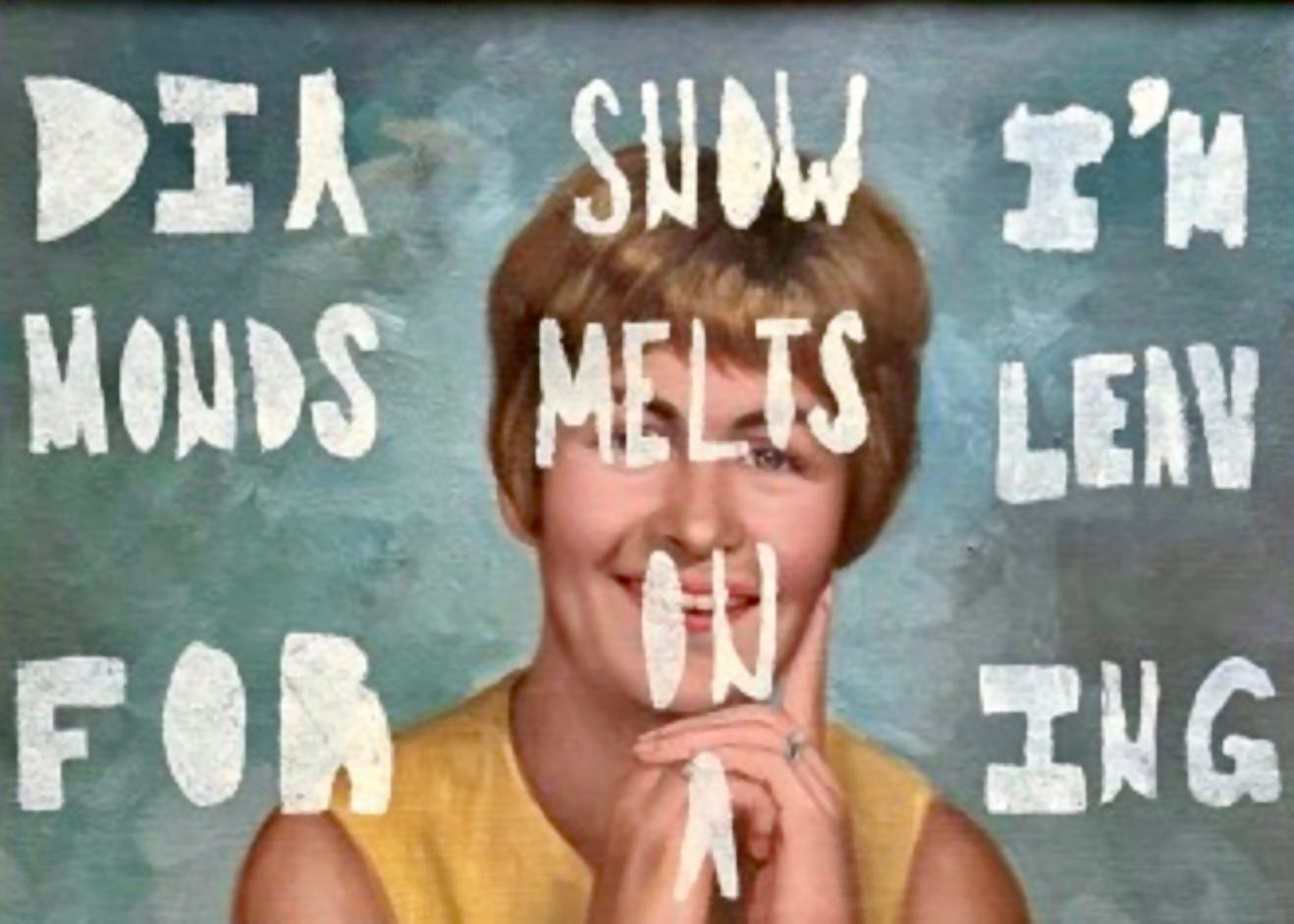
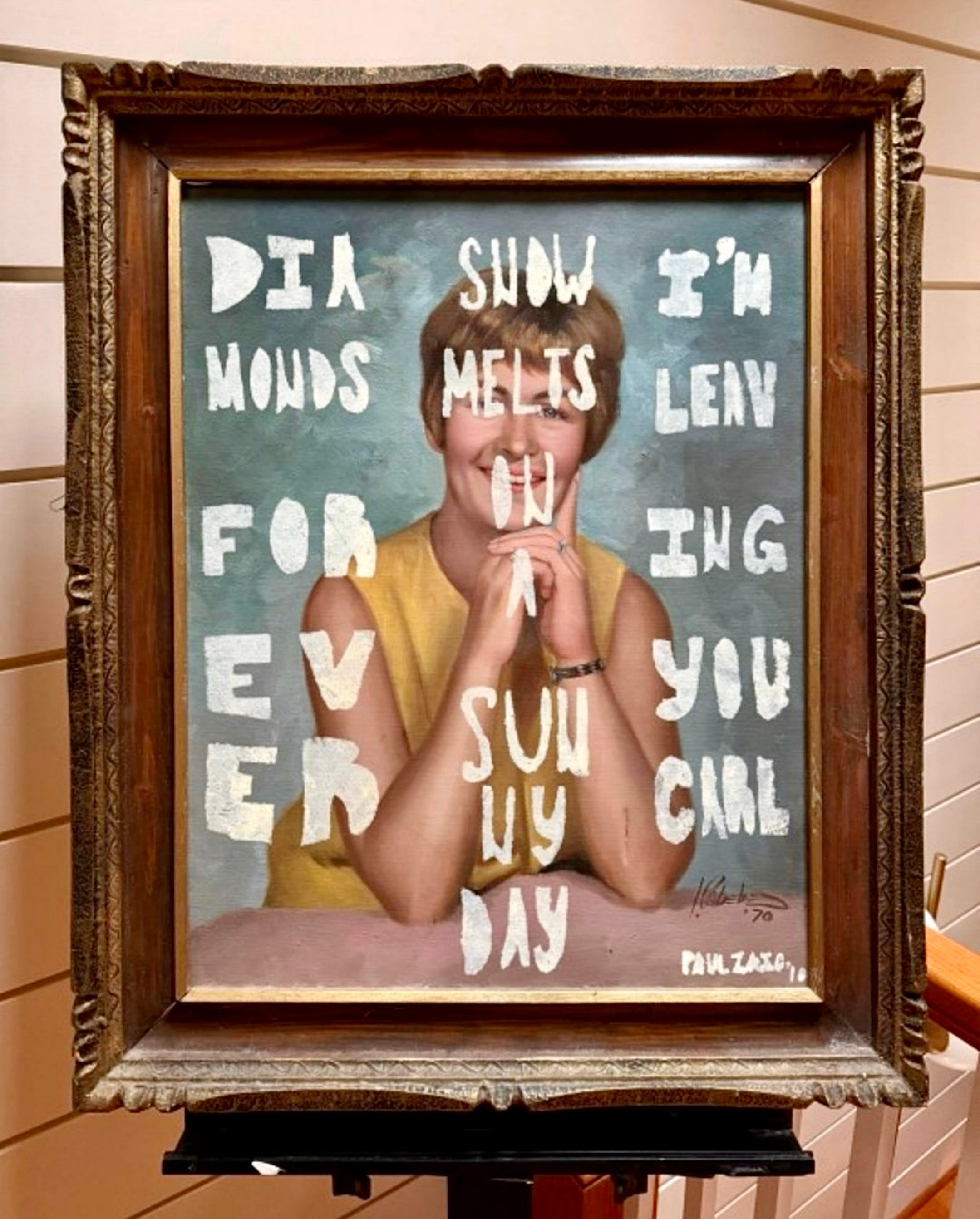
One day, at the thrift store, I came across an oil painting. It was a portrait of a blond woman in a yellow dress with Carol Brady hair. She was resting her chin on her hands. She had a diamond ring. She was smiling. It seemed to me that she had a secret.
The painting measured about three feet by four. It was clearly made with love. It had been framed professionally. It was signed and dated ‘70 by the artist. I hung it up in the kitchen of our little townhouse. We’d all be moving out soon. Things were already in boxes.
One night, as I was doing touch-up paint in the kitchen at the request of the grandpa from King of the Hill, I had a vision. I stayed up all night to make it a reality. I used my new X-ACTO knife to cut letter-shaped stencils into scraps of cardboard. I positioned them carefully over the oil painting of the woman in yellow and I filled them in with cheap, off-white house paint.
Soon thereafter, I moved back into my childhood home with my brother. My brother, who’d managed to graduate on time and hold a steady job during all that we’d been through together. He took care of me for a while. And once I’d settled in, it was time to find a job. I knew I needed to, but I was paralyzed by the thought. All of my grad school friends were either adults who’d come in as grown, working professionals or they were young people who’d nabbed their first professional gigs as grad students. I’d just quit Urban Outfitters before they could fire me.
I had panic attacks whenever I tried to work on my resume
I’d gone to the local Target and picked up an application, but I’d chickened out. I was twenty-seven years old.
One day, I did the only thing I was comfortable doing. As weird as it may seem, I drove to the old restaurant and asked if the owner was around. I explained that I really needed work and asked whether he had any openings for waiters. He said that he did. He was happy to have me back. I was so ashamed.
To my surprise, almost a decade after I’d left, a few of the same people were still working there. One of them was January, George’s wife. We had an awkward reunion.
“Is… George still here?” I said.
“No,” she said.
Something was wrong. She had a far-off look.
“No,” she said. “He and John moved back to the Philippines.”
“Oh,” I said.
Later, another one of the long-time servers pulled me aside.
“George and January got a divorce,” she said. “Yeah, it was… We don’t talk about George.”
I worked my ass off there. I got back in shape. I slowly got my mind back from the years of drinking. I was humiliated at first. The weather had rusted me. I was bad at waiting tables. Eventually, I was humbled. Eventually, I was mediocre at waiting tables.
And then one day, when it was time, I left
Diamonds forever
Snow melts on a sunny day
I'm leaving you, Carl
Paul Zaic
2010
Epilogue
As a single person, I hung Diamonds Forever proudly in every apartment I ever lived in. When I moved in with my wife, I gave it to my friend Dan, who hung it proudly in his single-person apartment. When he moved in with his wife, he gave it to a colleague at work. I reached out to Dan’s colleague on LinkedIn, and she was kind enough to send me pictures of it in its current home for me to use with this essay. Thank you to her and to Dan for taking such good care of it. And thank you to the woman in yellow, whoever you are.
Finally, I should say that George and January are real people, but those are not their real names.